

Narrative Inheritance: The Invisible Design of Everyday Life
On inherited stories, cultural conditioning and reclaiming imagination.

Some of the most influential inheritances are not material at all.
They arrive through stories.
Stories about success, productivity, ambition, relationships, beauty, intelligence, power, belonging, and what it means to live a “good life.” Stories absorbed long before people are old enough to question them.
Most are inherited unconsciously through family systems, schools, media, institutions, workplaces and culture itself. Over time, these assumptions become so normalised that they stop appearing as narratives altogether. They begin to feel like reality.
Much of what people experience as inevitable is inherited conditioning repeated often enough to become invisible.
Entire lives are shaped by narratives that were never consciously chosen.
Long before people form opinions about the world, they inherit emotional atmospheres and social assumptions that teach them what to value, fear, pursue, suppress and perform in order to belong.
Worth becomes tied to productivity. Exhaustion signals seriousness. Rest requires justification. Ambition must keep moving. Independence appears more valuable than interdependence. Speed becomes synonymous with progress, visibility with significance, scarcity with inevitability.
Collectively reinforced narratives rarely feel ideological. They feel neutral, natural, almost unquestionable, which is precisely what makes them so powerful.
Narratives as Infrastructure
We usually speak about storytelling as though it belongs primarily to books, films or marketing campaigns, but stories have always done something much deeper than entertain or communicate. Stories organise societies. They shape perception. They establish what feels acceptable, aspirational, realistic or impossible.
Entire economies function because enough people collectively believe certain ideas about value and success. Nations are held together through narratives about identity and belonging. Organisations operate through stories about professionalism, leadership, authority and achievement. Even our technologies are shaped by narratives about optimisation, efficiency, growth and what kind of future is worth building.
The systems we live inside are not separate from storytelling. They are expressions of storytelling.
This is why I keep returning to the idea that storytelling is infrastructure.
The systems we normalise today were first made imaginable through narrative. Before something becomes policy, culture, architecture or economics, it usually begins as an idea about how the world should function and what kind of life is worth pursuing.
Systems thinker Donella Meadows wrote that culture and paradigms — the underlying mindsets and assumptions out of which systems arise, are among the highest leverage points for transformation. That insight feels especially important right now because it reminds us that lasting change is never only structural or technological. It is also narrative, relational and deeply cultural.
The stories a society repeats eventually become the conditions people organise themselves around.
The most influential narratives are often the ones we no longer recognise as narratives at all. They become common sense.
Ideas like endless growth being inherently good, productivity determining human worth, competition appearing more natural than cooperation, burnout framed as the price of ambition, or humans existing separately from nature rather than within it.
These ideas are not objective truths. They are cultural constructions that have been repeated, rewarded and reinforced over time.
Once a story becomes embedded deeply enough into institutions and everyday life, it can begin to feel inevitable.
Narratives Live Inside the Body
What makes inherited narratives especially complex is that they do not live only in the intellect. They live in the body.
Stories repeated over generations eventually become habits, reflexes, nervous system patterns, emotional responses, and relational dynamics. A narrative absorbed deeply enough no longer feels like an external idea. It feels like identity.
The story of scarcity becomes chronic urgency.
The story of worthiness becomes perfectionism.
The story of survival becomes hyper-independence.
The story of professionalism becomes emotional suppression.
Sometimes what we call personality is adaptation to a story we once needed in order to belong.
This is partly why certain inherited narratives can feel so difficult to release, even when we intellectually recognise they are harming us. Many of them began as survival strategies.
Some were shaped by economic instability. Some emerged through migration, war, scarcity or social exclusion. Some were passed down through generations trying to protect themselves in systems that offered very little safety or support.
The problem is not that these narratives once existed. The problem is that survival stories carried for too long can become limitations.
I think many people today feel this tension intuitively. They sense that despite all the language around success, optimisation and self-improvement, something essential feels depleted.
We are becoming increasingly skilled at maximising ourselves inside systems that often remain fundamentally disconnected from wellbeing.
We learn how to become more efficient, more visible, more marketable, more productive, yet rarely stop to ask whether the underlying story itself is life-giving.
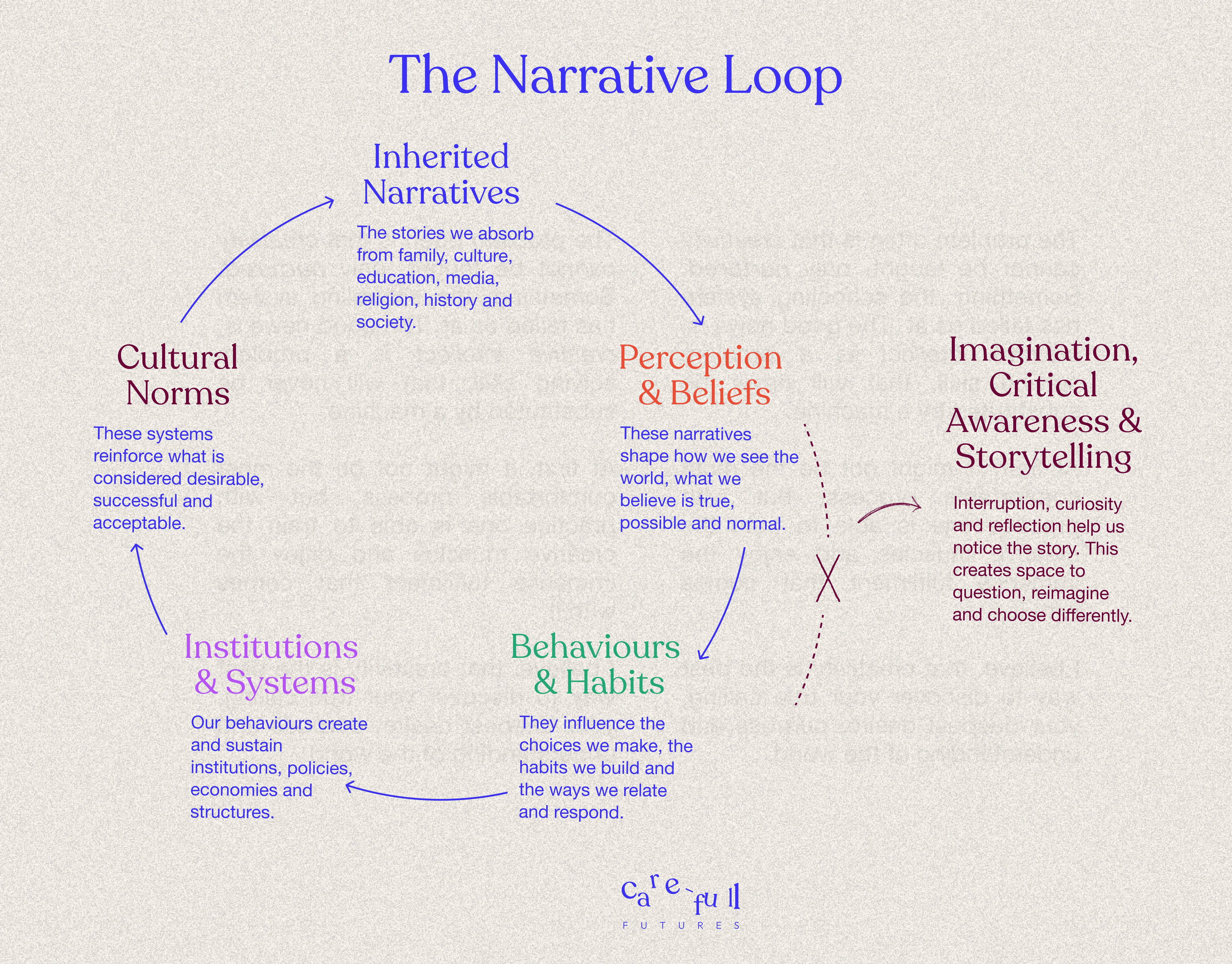
Stories shape perception. Perception shapes behaviour. Behaviour shapes systems.
Those systems reinforce the story all over again.
Imagination as Interruption
Imagination becomes profoundly important here.
I am not referring to imagination as fantasy or escapism. I mean imagination as the ability to perceive that things could be otherwise.
The moment we recognise a narrative as constructed rather than inevitable, something begins to open. Every transformation begins with a fracture in inevitability.
A significant number of systems shaping contemporary life persist not because they are functioning particularly well, but because people struggle to imagine coherent alternatives. Dominant narratives narrow perception until existing arrangements appear natural, permanent and unavoidable.
This is why storytelling matters far beyond branding or communication. Stories shape the horizon of what societies believe is possible.
If a culture cannot imagine an economy rooted in care rather than extraction, it will continue reproducing extractive systems. If people cannot imagine leadership beyond domination and control, they will continue normalising harmful power structures. If we cannot imagine futures rooted in reciprocity, interdependence, and enoughness, we remain trapped inside stories built around endless accumulation.
One of the deepest responsibilities of storytelling today is to interrupt inevitability.
I think this is also why so many people feel disoriented during periods of transition. When inherited narratives begin to crack, identity itself can feel unstable.
If productivity no longer defines my value, then what does?
If competition is not inevitable, what replaces it?
If extraction is unsustainable, how else might we organise economies, communities, or institutions?
If I stop performing the script I inherited, who do I become?
These are not abstract questions. They are deeply personal and deeply collective at the same time.
History repeatedly reminds us that social realities can change far faster than collective consciousness expects. Ideas once treated as unrealistic eventually become common sense. Entire cultural paradigms shift when enough people begin telling different stories about what matters and what kind of future is worth creating together.
The future is not shaped only by policy, innovation or technology. It is also shaped by imagination.
Reclaiming Authorship
We will always inherit stories from the cultures, systems and relationships we are part of. The question is not whether narratives shape us. They already do.
The real question is whether we remain unconscious participants in inherited scripts, or whether we begin choosing more intentionally which stories we nourish, embody, and pass forward.
Every story carries consequences.
Some stories deepen separation and normalize extraction. Some reward domination while disconnecting people from their own bodies, communities, and ecosystems. Some narrow the human capacity for tenderness, reciprocity, grief, repair, and care.
Other stories create entirely different conditions for life.
Stories rooted in interdependence rather than hyper-individualism.
Stories rooted in reciprocity rather than extraction.
Stories that value enoughness instead of endless accumulation.
Stories that understand well-being as collective rather than purely personal.
Stories that remind us we belong not above the living world, but within it.
The work of our time is not only to redesign systems, but to notice the narratives those systems have taught us to mistake for truth.
Reclaiming authorship does not require becoming untouched by culture. It requires becoming conscious enough to participate differently within it.
Once people begin noticing the stories shaping them, they also begin recovering the possibility that different futures can still be imagined, and therefore created.
Reflection Prompts
Which ideas about success, productivity, love, or worth feel “natural” to me, and where did they come from?
What narratives shaped the way I learned to relate to rest, ambition, care or belonging?
Which inherited stories feel life-giving, and which feel extractive or limiting?
What have I been taught to fear losing?
What systems do my daily choices unconsciously reinforce?
What possibilities become imaginable once a dominant narrative is questioned?
Which futures become possible when we stop treating current systems as inevitable?
What story am I living inside right now?
And is it still one I want to continue?
I believe the futures we move toward are shaped not only by policies, technologies or institutions, but by the stories we collectively believe about what is possible.
Right now, I feel an urgent need for more spaces where people can come together to question inherited narratives, expand their imagination and explore more regenerative ways of relating to ourselves, each other and the world around us.
Over the past months, I’ve been creating a new space around exactly this.
Stories We Become is now open for registration.
An 8-week journey into regenerative storytelling, systems thinking and futures imagination.
Narratives and the power of story is something I am becoming more and more interested about exploring lately. To me, it is pretty fascinating to acknowledge the power that lays behind a well-crafted story, no matter whether what it's sought to tell, and maybe even impose, is for the greater good, the not-so-good, or for the worst... I'm astonished to what these can do to our human mind and perception of the world. Even more when one realizes about stories having been a thing, for such a long period of time, pretty much all throughout humanity. Do you by any chance recommend any specific author or book(s) related to the topic to further explore about it? I am very curious about your space 'Stories We Become' and I am going to check it out as soon as I post this few words of mine. Also, I wanted to say, this piece is very well written and a truly beautiful and eye-opening one; thank you so much, Elena, for taking the time to put it together and share it. There are several quotes I must say resonated a lot with me, but these two, did so a little more: "Collectively reinforced narratives rarely feel ideological. They feel neutral, natural, almost unquestionable, which is precisely what makes them so powerful." & "Stories shape perception. Perception shapes behaviour. Behaviour shapes systems." Wishing to you and everyone who reads it, a wonderful week ahead to review, rethink, reimagine, and retell stories!
What a brilliant essay Elena, full of wisdom. I do have 1 suggestion based on my decades of working with personal narratives: how about turning some of those reflection questions into story prompts so readers can access their experiences with the topics you posed more directly? Just a thought.